Showing posts with label Video. Show all posts

Tuesday, June 29, 2010

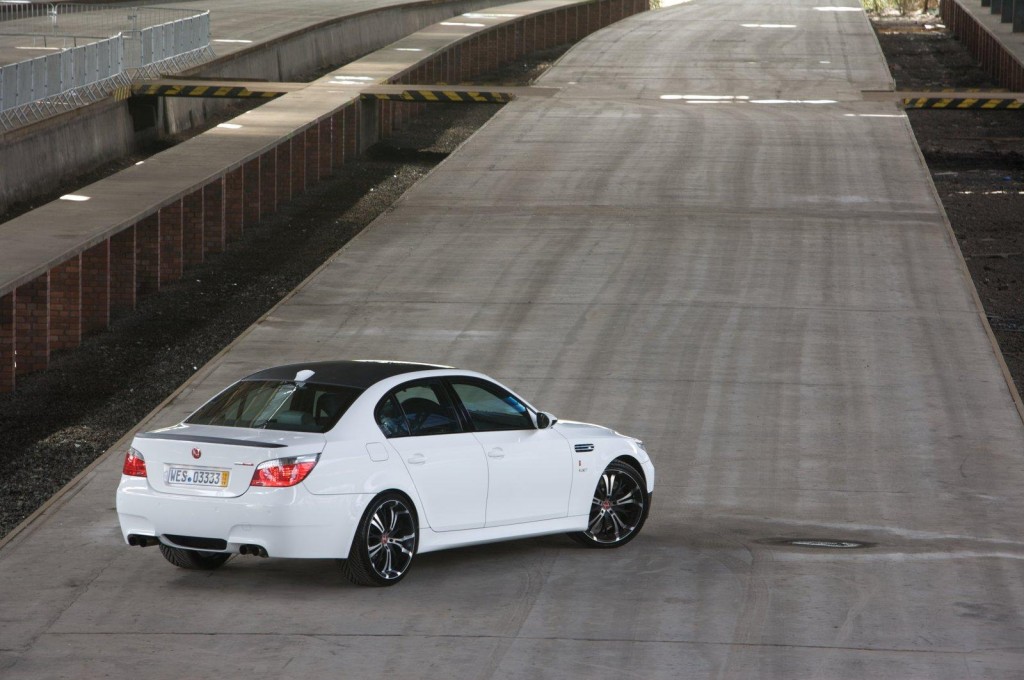
BMW M5 "Hans Nowack Edition"


Nowack Motors have released an upgrade package for the BMW M5 which was dubbed as the Hans Nowack Edition to honor the retirement of the M V10 engine. The cars upgrades are mainly in the engine compartment but this modified M5 also received a couple of styling changes such as two bespoke air collectors painted to match the exterior color.

Named the N635S 5.8 Hans Nowack Edition, the 5.0L V10 pushes out 718-hp over the factory 507-hp and revs up to 9000 rpm. This engine conversion is available for all the M5s and M6s sporting the 5.0L V10, and Nowack offers a 12 month warranty with no mileage constraint for those opting to have the work done. So while BMW is pushing ahead with their twin turbo setups and abandoning the joy of torque-heavy V10s, Nowack motors continues to embrace and give current owners a new option to compete with the new technology.

Since the HNE is just an engine makeover, all current M5s / M6s can be converted into a N635S 5.8 Hans Nowack Edition. Furthermore, since every engine is brand new after conversion, the company offers a 12 month warranty without a kilometer limitation.

Source: Nowack Motors


BMW M5 Hans Nowack Edition BMW M5 Hans Nowack Edition BMW M5 Hans Nowack Edition BMW M5 Hans Nowack Edition BMW M5 Hans Nowack Edition BMW M5 Hans Nowack Edition BMW M5 Hans Nowack Edition


Press Release

A farewell celebration for the naturally aspirated V10 masterpieces of the BMW M GmbH: NOWACK MOTORS created a world unique state-of-the-art masterpiece to celebrate the end of the era of high revving naturally aspirated BMW M engines, the N635S 5.8 "Hans Nowack Edition", offering an unmatchable maximum power output of 718hp at 9.000rpm.

NOWACK MOTORS, the world's no. 1 specialist company for engineering and manufacturing unique high performance engines on basis of all BMW M engines (4-, 6-, 8- and 10-cylinder) unveils a world unique naturally aspirated masterpiece, the N635S 5.8 "Hans Nowack Edition".

The N635S 5.8 is a tribute from Oliver Nowack to his father Hans, creator of world famed race and road engines and one of the inventors of what is nowadays called ECU-Tuning. Hans Nowack was an overall technical genius who always had his own approach when engineering and building high performance engines, resulting in numerous glorious victories of his cars in international motorsports, like e.g. the victory of the European Touring Car championship with a BMW 635CSi with driver Helmut Kelleners. He never stopped to invent world-class high performance engines, and after his active career, he continued to be a mentor for his son Oliver, who followed him in his footsteps most successfully. Hans Nowack died in 2005, and Oliver created this engine to pay tribute to the lifework of his father.

It definitely is the pinnacle of all high performance engines ever built on basis of the M GmbH's 5.0ltrs. V10 offering a standard maximum power output of 507hp.

Classic mechanical tuning techniques, the usage of the latest, most advanced coating materials and techniques combined with a most sophisticated, individual remap of the ECU were always NOWACK MOTORS' no. 1 choice when increasing power and torque of naturally aspirated engines, further enhancing the thrill that only a naturally aspirated high performance engine provides. Forced induction, neither by supercharging nor turbo charging, never was an option to increase the performance of the 5.0ltrs. V10 engine as it does not suit the engine's overall technical layout and characteristics. Furthermore, a forced induction engine based on a NA engine never offers the refinement and reliability of a perfectly engineered and manufactured naturally aspirated high performance engine. Thus, it is the ultimate challenge for every high performance engine manufacturer.

Each NOWACK MOTORS N635S 5.8 ?Hans Nowack Edition" is equipped with two NOWACK MOTORS bespoke intake air collectors with a higher air volume in order to provide the engine with sufficient intake air quantity.

The colour of the paintwork for the air collectors is being determined by the exterior colour of the car.

Only this time, the name differs from all other NOWACK MOTORS creations. The name does not reveal the actual maximum power output of the engine, clearly separating this unique showcase of highly sophisticated manufacture of internal combustion engines from the N700 4.8 with 715hp, the latest high performance engine creation based on the new 4.4ltrs. BMW M Biturbo V8 engine of the new era being used in the X5M and X6M. As we all know, this engine will be used to propel the upcoming new M5 of the F10 series by next year.

All internal parts of the engine are being replaced by NOWACK MOTORS' high performance parts, thus every M5/M6 (also cars with a higher mileage), can be converted to a NOWACK MOTORS N635S 5.8 "Hans Nowack Edition".

As every engine is brand new after the conversion, NOWACK MOTORS provides an engine warranty of 12 months without kilometer limitation.

Please visit NOWACK MOTORS' website at: www.nowack-motors.com for further informations.

BMW M5 "Hans Nowack Edition"


Nowack Motors have released an upgrade package for the BMW M5 which was dubbed as the Hans Nowack Edition to honor the retirement of the M V10 engine. The cars upgrades are mainly in the engine compartment but this modified M5 also received a couple of styling changes such as two bespoke air collectors painted to match the exterior color.

Named the N635S 5.8 Hans Nowack Edition, the 5.0L V10 pushes out 718-hp over the factory 507-hp and revs up to 9000 rpm. This engine conversion is available for all the M5s and M6s sporting the 5.0L V10, and Nowack offers a 12 month warranty with no mileage constraint for those opting to have the work done. So while BMW is pushing ahead with their twin turbo setups and abandoning the joy of torque-heavy V10s, Nowack motors continues to embrace and give current owners a new option to compete with the new technology.

Since the HNE is just an engine makeover, all current M5s / M6s can be converted into a N635S 5.8 Hans Nowack Edition. Furthermore, since every engine is brand new after conversion, the company offers a 12 month warranty without a kilometer limitation.

Source: Nowack Motors


BMW M5 Hans Nowack Edition BMW M5 Hans Nowack Edition BMW M5 Hans Nowack Edition BMW M5 Hans Nowack Edition BMW M5 Hans Nowack Edition BMW M5 Hans Nowack Edition BMW M5 Hans Nowack Edition


Press Release

A farewell celebration for the naturally aspirated V10 masterpieces of the BMW M GmbH: NOWACK MOTORS created a world unique state-of-the-art masterpiece to celebrate the end of the era of high revving naturally aspirated BMW M engines, the N635S 5.8 "Hans Nowack Edition", offering an unmatchable maximum power output of 718hp at 9.000rpm.

NOWACK MOTORS, the world's no. 1 specialist company for engineering and manufacturing unique high performance engines on basis of all BMW M engines (4-, 6-, 8- and 10-cylinder) unveils a world unique naturally aspirated masterpiece, the N635S 5.8 "Hans Nowack Edition".

The N635S 5.8 is a tribute from Oliver Nowack to his father Hans, creator of world famed race and road engines and one of the inventors of what is nowadays called ECU-Tuning. Hans Nowack was an overall technical genius who always had his own approach when engineering and building high performance engines, resulting in numerous glorious victories of his cars in international motorsports, like e.g. the victory of the European Touring Car championship with a BMW 635CSi with driver Helmut Kelleners. He never stopped to invent world-class high performance engines, and after his active career, he continued to be a mentor for his son Oliver, who followed him in his footsteps most successfully. Hans Nowack died in 2005, and Oliver created this engine to pay tribute to the lifework of his father.

It definitely is the pinnacle of all high performance engines ever built on basis of the M GmbH's 5.0ltrs. V10 offering a standard maximum power output of 507hp.

Classic mechanical tuning techniques, the usage of the latest, most advanced coating materials and techniques combined with a most sophisticated, individual remap of the ECU were always NOWACK MOTORS' no. 1 choice when increasing power and torque of naturally aspirated engines, further enhancing the thrill that only a naturally aspirated high performance engine provides. Forced induction, neither by supercharging nor turbo charging, never was an option to increase the performance of the 5.0ltrs. V10 engine as it does not suit the engine's overall technical layout and characteristics. Furthermore, a forced induction engine based on a NA engine never offers the refinement and reliability of a perfectly engineered and manufactured naturally aspirated high performance engine. Thus, it is the ultimate challenge for every high performance engine manufacturer.

Each NOWACK MOTORS N635S 5.8 ?Hans Nowack Edition" is equipped with two NOWACK MOTORS bespoke intake air collectors with a higher air volume in order to provide the engine with sufficient intake air quantity.

The colour of the paintwork for the air collectors is being determined by the exterior colour of the car.

Only this time, the name differs from all other NOWACK MOTORS creations. The name does not reveal the actual maximum power output of the engine, clearly separating this unique showcase of highly sophisticated manufacture of internal combustion engines from the N700 4.8 with 715hp, the latest high performance engine creation based on the new 4.4ltrs. BMW M Biturbo V8 engine of the new era being used in the X5M and X6M. As we all know, this engine will be used to propel the upcoming new M5 of the F10 series by next year.

All internal parts of the engine are being replaced by NOWACK MOTORS' high performance parts, thus every M5/M6 (also cars with a higher mileage), can be converted to a NOWACK MOTORS N635S 5.8 "Hans Nowack Edition".

As every engine is brand new after the conversion, NOWACK MOTORS provides an engine warranty of 12 months without kilometer limitation.

Please visit NOWACK MOTORS' website at: www.nowack-motors.com for further informations.

Friday, June 25, 2010

Audi TTS Pikes Peak [Video]


Audi has unveiled today a new version of the Autonomous Audi TTS Pikes Peak, the car that can drive itself.the first details of the Audi TTS Pikes Peak were revealed in October last year and today the Ingolstadt manufacturer has come with new details. The car features a new livery that honors the company's past rally drivers.

With the changed appearance, the Autonomous Audi TTS Pikes Peak is now squarely aligned with Audi cars that made motorsports history a generation ago in the Pikes Peak Hill Climb and other rally racing events.

The sensing hardware of the TTS is using a different approach from earlier autonomous vehicles. Instead of the array of cameras, laser and radar, this car is using only high precision differential GPS along with the inertial sensors that are part of the stability control system. Driving is handled by a pair of computers in the trunk with hardware comparable to a laptop. One machine runs the sensing software and safety algorithms while the other handles the vehicle dynamics. The latter is being developed to let the TTS run like a rally car, drifting on gravel corners in order to get maximum speed.


Audi TTS Pikes PeakAudi TTS Pikes PeakAudi TTS Pikes PeakAudi TTS Pikes PeakAudi TTS Pikes PeakAudi TTS Pikes PeakAudi TTS Pikes PeakAudi TTS Pikes PeakAudi TTS Pikes Peak


Press Release

Audi today launched a bold new design for the Pikes Peak Autonomous Audi TTS, as research surrounding the car that can drive itself enters a crucial stage leading to the goal of a high-speed test up Pikes Peak in Colorado this fall.

With the changed appearance, the Pikes Peak Autonomous Audi TTS is now squarely aligned with Audi cars that made motorsports history a generation ago in the Pikes Peak Hill Climb and other rally racing events.

The new emphasis for the project also honors quattro® technology, which has played an instrumental role in Audi racing successes, has served as a leading example of the progressive engineering found in Audi passenger vehicles and is integral to the handling of the Pikes Peak Autonomous Audi TTS. This year marks the 30th anniversary of quattro on the world automotive stage.

The association between Pikes Peak and this research project relates to the original goal of developing advanced algorithms and actuation systems that would allow a car to complete a driving course without a human behind the wheel. The partners in developing this technology – the Stanford University Dynamic Design Lab (DDL), the Electronics Research Lab (ERL) for the Volkswagen Group in Palo Alto, Calif., and Oracle. – chose the part-pavement, part-gravel route of the storied Pikes Peak race to prove the project's capabilities.

'Our aim from the start has been to show how the future of driver assistance technologies will lead to dramatic improvements in traffic safety and saving lives,' said Dr. Burkhard Huhnke, Executive Director, ERL. 'With this project we are working on electronics that will help drivers steer their way out of dangerous situations. But first we need to create programs that would replicate the quick decisions and rapid maneuvers of the best rally racers under the most difficult road conditions.'

The connection with rally racing provided another key inspiration to the project team.

'Many of the leading automotive technologies we see in our cars today evolved out of motorsports,' said mechanical engineering Associate Professor Chris Gerdes, director of the Center for Automotive Research at Stanford, in Palo Alto, Calif. 'This is because racing pushes emerging technologies to the limits before they can be adopted more broadly.'

The Pikes Peak Autonomous Audi TTS is based on a street-ready Audi TTS sports car. The team chose the TTS because its native systems, including a drive-by-wire throttle and a semiautomatic DSG gearbox were a good fit with the electronics that allow the car to drive without human input.

The computing hardware added to the Pikes Peak TTS isn't significantly more elaborate than what can be found in a standard laptop. The car currently uses two computers in its trunk – one running safety critical algorithms using Oracle Java Real-Time System (Java RTS). The other runs vehicle dynamics algorithms. The two sets of algorithms are what enable the Pikes Peak TTS to drive at the limits of handling on a variety of surfaces, speeds and conditions.

The differential GPS system is capable of keeping the Pikes Peak TTS within two centimeters of the center line of a normal course; researchers are planning on a one-meter margin on Pikes Peak due to the extreme conditions.

The Pikes Peak Autonomous Audi TTS gained global recognition last year with a Web video that showcased the car's ability to execute complex maneuvers on Utah's Bonneville Salt Flats without a human behind the steering wheel.

In the Pikes Peak Hill Climb, Audi legends were born a generation ago. Audi rally cars, such as the Audi S1 quattro, employed the all-wheel drive technology to win the 12.42-mile 'Race to the Clouds' in convincing fashion. The drivers of those Audi quattro rally cars – Bobby Unser, Walter Roehrl and Michele Mouton – earned places in motorsports history at Pikes Peak. In fact, the researchers from Stanford and the Volkswagen Group's Electronics Research Laboratory in Palo Alto, Calif., nicknamed the project 'Shelley' after Mouton and her racing exploits.

The S1 also inspired the 'S' range of performance models, such as today's critically acclaimed Audi S4 sedan.

Tying the Audi traditions into a look for the Pikes Peak Autonomous Audi TTS became an engaging assignment for Audi designers at the company's Design Center California in Santa Monica. Several options emerged, including an art car look that depicted the Pikes Peak route in a topographic map covering the body of the TTS.

For the design that was selected, the goal was to pay homage to the past, while conveying the leading-edge technology that defines the Pikes Peak Autonomous Audi TTS. Designers decided to give the rally car themes from the 1980s a forward-looking twist, said Sangyup Lee, Chief Designer (Group Exterior) at VW/Audi Group Studio California.

The original rally cars, for example didn't feature a large four rings logo on their roofs. But the designers used that design cue from modern Audi DTM racing cars in Europe so the brand image would be evident in aerial photos and videos.

'We were very much inspired by the Pikes Peak race cars,' noted Raul Cenan, Lead Designer on the Pikes Peak TTS project. 'But there was very different technology used in those cars overall. So we decided to go with more modern elements that were heritage-inspired.'

TIMELINE FOR THE PIKES PEAK AUTONOMOUS AUDI TTS

The highlight of the months ahead of the Pikes Peak Autonomous TTS is the planned high-speed testing up Pikes Peak in September. The entire route of the challenging Pikes Peak Hill Climb with be the course that the research car will attempt to complete.

June 27-29: Researchers visit Pikes Peak to collect data points, scout locations immediately after the 2010 Pikes Peak Hill Climb race.

July-August: Continued testing to prepare for Pikes Peak attempt.

September: Pikes Peak autonomous attempt, conditions permitting. This will be closed to the public, due to the extreme nature of the course. But the testing will be certified by an independent motorsports organization.

Mid-November: Weather permitting, a Guinness Book of World Records land speed attempt at the El Mirage Lake dry-lake bed in southern California or another nearby location . Officials from the Guinness Book plan to certify whether the Pikes Peak TTS establishes a record in the new category of fastest speed in an autonomous vehicle. Media coverage details will be forthcoming.

Thursday, June 24, 2010

Ford Mustang V6 aims for 1,000 laps of Bristol track on one tank of fuel


How many laps of Bristol Motor Speedway will a V6-powered Ford Mustang run on one tank of fuel? Ford is about to find out as part of a marketing effort for the car, which got new V6 and V8 powertrains for the 2011 model year.


The 2011 Ford Mustang with its 305-hp 3.7L V6 engine set a new record by averaging 48.5 mpg on a track while completing 1,457 laps at an average speed of 43.9 mph.


The 2011 Mustang V6 has spent about 12 hours going 1000 laps on ¾ of a tank of gas and that would suggest that the Mustang has roughly 3-4 hours left and if they maintain an average of 43mph (they are shooting for 45, but there are stops and such), they are on a pace to run 129-172 more miles, or 242 to 322 laps - finishing up somewhere between 11pm and midnight.


Of course that 48.5 mpg record has been achieved by driving consistently on a track with average speed of 43.9 mph. The real life economy of the V6 Mustang is 31 mpg which is still very impressive considering that it delivers 305 hp. We’d just like to say well done to Ford and all those drivers who tolerated hours hours of mind-numbingly boring consistent economy driving to set this record!


So anyone who placed their bets on whether or not the Mustang had it in him, either start collecting or start paying. The Mustang proves to be a killer muscle car that wipes the floor with the 29mpg highway of the 2011 Chevrolet Camaro and the 26mpg of the 2010 Dodge Charger.


2011 Ford Mustang 1,000 lap challenge 2011 Ford Mustang 1,000 lap challenge 2011 Ford Mustang 1,000 lap challenge 2011 Ford Mustang 1,000 lap challenge 2011 Ford Mustang 1,000 lap challenge 2011 Ford Mustang 1,000 lap challenge 2011 Ford Mustang 1,000 lap challenge 2011 Ford Mustang 1,000 lap challenge


Press Release


MUSTANG V-6 AVERAGES 48.5 MPG; RUNS 1,457 LAPS AT BRISTOL ON A SINGLE TANK OF GAS


  • The 2011 Ford Mustang V-6 sets a new record by averaging 48.5 mpg on a track while completing 1,457 laps with an average speed of 43.9 mph
  • Mustang is powered by a new 3.7-liter V-6 engine that uses advanced engineering and technology to deliver great performance and fuel economy
  • More than 51,000 entries were received for the Mustang 1,000 Lap Challenge with 22 entries guessing the winning number of laps
  • A team of five drivers, including four Ford Mustang engineers and Ford NASCAR star David Ragan, drove the Mustang during its record run


Mustang 1,000 Lap Challenge


BRISTOL, TN., June 24, 2010 – The 2011 Ford Mustang, which made history when it became the first car ever to deliver more than 30 mpg and 305 horsepower, has set a new record by running 1,457 laps at Bristol Motor Speedway while averaging 48.5 mpg.


The Mustang 1,000 Lap Challenge was designed to demonstrate that a stock production Mustang V-6 could run 1,000 laps and 533 miles on a single of tank of fuel. With the aid of fuel efficient driving techniques by Ford engineers, the Mustang far surpassed its goal of 1,000 laps.


"To see a Mustang post average fuel economy of 48.5 mpg while running at Bristol is impressive," said Dave Pericak, Mustang chief engineer. "The new V-6 engine along with the advanced six-speed transmission in the car is a key element in delivering both fuel economy and performance for Mustang."


Ford is committed to being a fuel economy leader in every segment it competes in and Mustang's leads in its class along with other Ford fuel economy leaders like the Ford Fiesta, Fusion Hybrid and new Lincoln MKZ Hybrid, America's most fuel efficient luxury sedan.


The Challenge team, which included NASCAR star David Ragan and four Ford Mustang engineers, completed the challenge in 17 hours and 40 minutes, showing off the 2011 Mustang V-6's class-leading fuel economy by averaging 48.5 mpg over the course of the 776.5 miles logged during the Challenge. That distance is more than the two complete NASCAR Sprint Cup events that take place in Bristol every year.


Ragan pushed the Mustang past the 1,000-lap mark at 7:26 p.m., 12 hours and 26 minutes into the Challenge, but the car wasn't close to being out of fuel. Mustang engineer Seong Park was behind the wheel when it finally came to a halt (on the backstretch) of the famed NASCAR track at 12:41 a.m. local time.


Other Mustang Challenge team drivers included Tom Barnes, Jonathan Mehl and Carl Ek, who along with Park, rotated through one-hour driving stints during the event, which took place at the world's fastest half-mile track.


"When we hit 1,000 laps we still had a quarter of a tank of gas left," said David Ragan, driver of the No. 6 UPS Ford Fusion for Roush Fenway Racing, and the man who drove the 2011 V-6 Mustang past the 1,000 lap mark. "The last driving stint before I passed 1,000 laps I was averaging 43.7 miles a gallon and that is unbelievable. These guys have run the distance of more than two Sprint Cup races at Bristol and they still have fuel left. Congratulations to everyone behind the Mustang and to everyone at Ford, because this 2011 Mustang V-6 is really something special."


A team of Ford engineers prepared for the challenge by implementing fuel efficient driving tips like minimizing the use of air conditioning, steady and consistent driving, avoiding sudden stops/starts and by keeping the RPMs low. The engine in the Mustang is powered by a lightweight, all-aluminum 3.7-liter dual-overhead-cam (DOHC) V-6 engine that uses advanced engineering to deliver its combination of power and economy. Twin independent variable camshaft timing (Ti-VCT) adjusts the valve train in microseconds depending on driver inputs, further contributing to the engine's overall efficiency. The Mustang used in the challenge is a stock production vehicle that can be purchased through a Ford dealer.


"This is beyond our wildest dreams," said Tom Barnes, the lead engineer for the Ford Mustang 1,000 Lap Challenge. "There have been a lot of people who have done a lot of things in preparing this 2011 Mustang V-6 to run the Mustang 1,000 Lap Challenge and have the success we have had today. It was great when we went past the 1,000 lap mark with David, but nobody could ever imagine that we still had five hours ahead of us. This is a fantastic feeling and it shows again what a great car the 2011 Mustang V-6 is."


More than 51,000 consumers registered their guesses for the event at www.mustang1000lapchallenge.com. One lucky consumer that correctly guessed 1,457 laps will be randomly drawn from all correct entries and will win their own 2011 Mustang V-6.


Ford Mustang V6 aims for 1,000 laps of Bristol track on one tank of fuel


How many laps of Bristol Motor Speedway will a V6-powered Ford Mustang run on one tank of fuel? Ford is about to find out as part of a marketing effort for the car, which got new V6 and V8 powertrains for the 2011 model year.


The 2011 Ford Mustang with its 305-hp 3.7L V6 engine set a new record by averaging 48.5 mpg on a track while completing 1,457 laps at an average speed of 43.9 mph.


The 2011 Mustang V6 has spent about 12 hours going 1000 laps on ¾ of a tank of gas and that would suggest that the Mustang has roughly 3-4 hours left and if they maintain an average of 43mph (they are shooting for 45, but there are stops and such), they are on a pace to run 129-172 more miles, or 242 to 322 laps - finishing up somewhere between 11pm and midnight.


Of course that 48.5 mpg record has been achieved by driving consistently on a track with average speed of 43.9 mph. The real life economy of the V6 Mustang is 31 mpg which is still very impressive considering that it delivers 305 hp. We’d just like to say well done to Ford and all those drivers who tolerated hours hours of mind-numbingly boring consistent economy driving to set this record!


So anyone who placed their bets on whether or not the Mustang had it in him, either start collecting or start paying. The Mustang proves to be a killer muscle car that wipes the floor with the 29mpg highway of the 2011 Chevrolet Camaro and the 26mpg of the 2010 Dodge Charger.


2011 Ford Mustang 1,000 lap challenge 2011 Ford Mustang 1,000 lap challenge 2011 Ford Mustang 1,000 lap challenge 2011 Ford Mustang 1,000 lap challenge 2011 Ford Mustang 1,000 lap challenge 2011 Ford Mustang 1,000 lap challenge 2011 Ford Mustang 1,000 lap challenge 2011 Ford Mustang 1,000 lap challenge


Press Release


MUSTANG V-6 AVERAGES 48.5 MPG; RUNS 1,457 LAPS AT BRISTOL ON A SINGLE TANK OF GAS


  • The 2011 Ford Mustang V-6 sets a new record by averaging 48.5 mpg on a track while completing 1,457 laps with an average speed of 43.9 mph
  • Mustang is powered by a new 3.7-liter V-6 engine that uses advanced engineering and technology to deliver great performance and fuel economy
  • More than 51,000 entries were received for the Mustang 1,000 Lap Challenge with 22 entries guessing the winning number of laps
  • A team of five drivers, including four Ford Mustang engineers and Ford NASCAR star David Ragan, drove the Mustang during its record run


Mustang 1,000 Lap Challenge


BRISTOL, TN., June 24, 2010 – The 2011 Ford Mustang, which made history when it became the first car ever to deliver more than 30 mpg and 305 horsepower, has set a new record by running 1,457 laps at Bristol Motor Speedway while averaging 48.5 mpg.


The Mustang 1,000 Lap Challenge was designed to demonstrate that a stock production Mustang V-6 could run 1,000 laps and 533 miles on a single of tank of fuel. With the aid of fuel efficient driving techniques by Ford engineers, the Mustang far surpassed its goal of 1,000 laps.


"To see a Mustang post average fuel economy of 48.5 mpg while running at Bristol is impressive," said Dave Pericak, Mustang chief engineer. "The new V-6 engine along with the advanced six-speed transmission in the car is a key element in delivering both fuel economy and performance for Mustang."


Ford is committed to being a fuel economy leader in every segment it competes in and Mustang's leads in its class along with other Ford fuel economy leaders like the Ford Fiesta, Fusion Hybrid and new Lincoln MKZ Hybrid, America's most fuel efficient luxury sedan.


The Challenge team, which included NASCAR star David Ragan and four Ford Mustang engineers, completed the challenge in 17 hours and 40 minutes, showing off the 2011 Mustang V-6's class-leading fuel economy by averaging 48.5 mpg over the course of the 776.5 miles logged during the Challenge. That distance is more than the two complete NASCAR Sprint Cup events that take place in Bristol every year.


Ragan pushed the Mustang past the 1,000-lap mark at 7:26 p.m., 12 hours and 26 minutes into the Challenge, but the car wasn't close to being out of fuel. Mustang engineer Seong Park was behind the wheel when it finally came to a halt (on the backstretch) of the famed NASCAR track at 12:41 a.m. local time.


Other Mustang Challenge team drivers included Tom Barnes, Jonathan Mehl and Carl Ek, who along with Park, rotated through one-hour driving stints during the event, which took place at the world's fastest half-mile track.


"When we hit 1,000 laps we still had a quarter of a tank of gas left," said David Ragan, driver of the No. 6 UPS Ford Fusion for Roush Fenway Racing, and the man who drove the 2011 V-6 Mustang past the 1,000 lap mark. "The last driving stint before I passed 1,000 laps I was averaging 43.7 miles a gallon and that is unbelievable. These guys have run the distance of more than two Sprint Cup races at Bristol and they still have fuel left. Congratulations to everyone behind the Mustang and to everyone at Ford, because this 2011 Mustang V-6 is really something special."


A team of Ford engineers prepared for the challenge by implementing fuel efficient driving tips like minimizing the use of air conditioning, steady and consistent driving, avoiding sudden stops/starts and by keeping the RPMs low. The engine in the Mustang is powered by a lightweight, all-aluminum 3.7-liter dual-overhead-cam (DOHC) V-6 engine that uses advanced engineering to deliver its combination of power and economy. Twin independent variable camshaft timing (Ti-VCT) adjusts the valve train in microseconds depending on driver inputs, further contributing to the engine's overall efficiency. The Mustang used in the challenge is a stock production vehicle that can be purchased through a Ford dealer.


"This is beyond our wildest dreams," said Tom Barnes, the lead engineer for the Ford Mustang 1,000 Lap Challenge. "There have been a lot of people who have done a lot of things in preparing this 2011 Mustang V-6 to run the Mustang 1,000 Lap Challenge and have the success we have had today. It was great when we went past the 1,000 lap mark with David, but nobody could ever imagine that we still had five hours ahead of us. This is a fantastic feeling and it shows again what a great car the 2011 Mustang V-6 is."


More than 51,000 consumers registered their guesses for the event at www.mustang1000lapchallenge.com. One lucky consumer that correctly guessed 1,457 laps will be randomly drawn from all correct entries and will win their own 2011 Mustang V-6.


Tuesday, June 22, 2010

2010 Ford Focus RS Le Mans Classic Editions – five different identities [video]


Ford has just unveiled five different one-off versions of the Ford Focus RS Le Mans Classic special edition. The new special edition are meant to celebrate the French classic that takes place this year between July 9th and 11th. The number 5 was not chosen by chance. Each of the five Ford Focus RS Le Mans special model will celebrate one of the cars that brought the Blue Oval a victory in the 24 Hours classic race.

The list of five special Focus RS models will include: a black with silver stripes edition that pays tribute to a Ford Mk II, which was victorious in 1966; a red model with white stripes that is recalling the Mk IV which won in 1967; a white model with a thin blue center stripe surrounded by a red border that pays tribute to the beautiful Ford Mk IIB, entered by Ford France in the 1967 Le Mans 24-hours; a two-tone sky blue and orange edition reference to the modern GT40s which dominated Le Mans in 1968 and 1969 and a two-tone white and blue model representing the livery of the Capri RS 2600 which took the Touring category in 1972.

Each car includes four Recaro seats wrapped in stitched leather and quilted Alcantara, in contrasting colors meant to match the exteriors.  This is replicated at the gearshift, hand brake, and center arm rest.  Front seats also get the advantage of leather seat belts.

The five cars will be seen in action at the 2010 Le Mans Classic in July, and will be joined on the track by the recently released limited-edition Ford Focus RS500, whose exclusive matt black finish will be an equally eye-catching addition to the palette of colors which have fired the imaginations of countless fans of Ford and the greatest endurance race in the world.


Ford Focus RS Le Mans Ford Focus RS Le Mans Ford Focus RS Le Mans Ford Focus RS Le Mans Ford Focus RS Le Mans Ford Focus RS Le Mans Ford Focus RS Le Mans Ford Focus RS Le Mans


Press Release

FORD FOCUS RS LE MANS CLASSIC: A COLLECTION OF 5 UNIQUE EXAMPLES CREATED TO PAY TRIBUTE TO LEGENDARY FORD LE MANS RACERS

Saint-Germain-en-Laye, 21 June 2010 - Ecurie Ford France, one of the partners of the popular Le Mans Classic event which takes place between July 9th and 11th, has prepared a collection of just five Focus RS cars in unique colour schemes, each paying tribute to the Ford cars which made 'blue oval' history at the Le Mans 24 Hours.

Each of the five Focus RS Le Mans Classic vehicles will be finished in the colours of one of the Ford cars which made 24 Hours history for Ford. During the event itself, they will even carry the race number of the cars to which they're paying tribute:

  • Black with silver stripes: a reference to the Ford Mk II, which was victorious in 1966.
  • Red with white stripes: recalling the Mk IV which won in 1967.
  • White with a thin blue centre stripe surrounded by a red border: echoing the decoration of the beautiful Ford Mk IIB, entered by Ford France in the 1967 Le Mans 24-hours.
  • Two-tone sky blue and orange: A modern take on the GT40s which dominated Le Mans in 1968 and 1969.
  • Two-tone white and blue: representing the livery of the Capri RS 2600 which took the Touring category in 1972.

All five exclusive Focus RS vehicles also have customised interiors. The Recaro seats are upholstered in leather and diamond-quilted alcantara, front and back, with stitching that matches the bodywork. The gearshift gaiter, hand brake handle and central arm-rest are upholstered in real leather, and a leather safety belt guide has been added to the front seats.

Each of the five cars will carry a personalised numbered plaque on the dashboard confirming its exclusivity as part of the collection.

The five cars will be seen in action at the 2010 Le Mans Classic in July, and will be driven on a number of laps of the full track at the start of a number of the different 'grid' races reserved for cars of a particular era, with Ford-invited special guests and VIPs at the wheel.

The Focus RS Le Mans Classic units will be joined on the track by the limited edition Ford Focus RS500, whose futuristic matt black livery will be an equally eye-catching addition to the palette of colours which have fired the imaginations of countless fans of Ford and the greatest endurance race in the world.

Only Five For Sale
Once the fifth Le Mans Classic event is over, these five unique Focus RS Le Mans Classic vehicles will be put up for sale, and will be offered with exclusive accessories. Fitted with either RS(1) or RS Technology(2) packs, they will be supplied with a Le Mans Classic watch - a 3-dial automatic chronograph with large date display and sapphire background of which only 600 are to be produced.

The 5 cars to which the Ford Focus RS Le Mans Classic is paying tribute:

The Ford Mk II (victorious in 1966): on the 18th of June 1966, Henry Ford II himself gave the starting signal for the 24th Le Mans 24 Hours. He let loose a pack of fifty-five vehicles led out by two of the eight Mk IIs entered by the manufacturer plus six GT40s, including one belonging to Ford France which was driven by Guy Ligier and the American Bob Grossman. The duel with Ferrari was at its peak for this "race of the century". Unbeaten since 1960, the Italian marque was the queen of Le Mans. However, this time it was the Americans who dominated, pulling off a spectacular triple! For the first time ever, the 200km/h average speed barrier was broken at Le Mans.

The Ford Mk IV (winner in 1967): Wanting revenge, Ferrari sent its formidable 330 P4s to challenge the Mk IVs in a face-to-face battle without mercy. However, it was all in vain. The unstoppable red, white-trimmed Mk IV, piloted by Dan Gurney and A.J. Foyt, wiped the floor with Lodovico Scarfiotti and Mike Parkes' P4. Unforgettable new pages in the history of motor sport were being written before everyone's eyes. The epic tale of the Mk IIs and Mk IVs concluded with the spectacular distance (5,232.9 km) and average speed (218 km/h!) records set by Ford that year.

The Ford GT40 (victorious in 1968 and 1969): Even though Ford as a manufacturer was not directly involved, John Wyer's JWA team benefitted from Gulf Oil sponsorship and the blessing of Ford Dearborn. For their first outing in 1968, the GT40s faced some keen and challenging competition from Porsche and Alfa Romeo. Driven by Pedro Rodriguez and Lucien Bianchi, the GT40 clearly dominated the field ahead of a Porsche 907 and three Alfa Romeo 33/2s. This third consecutive Ford victory was the first for a genuine GT40.

In 1969, competition was as intense and varied as ever: Porsche was in attendance with its 908s and its new 917s, Matra introduced its 630/650s and Ferrari was back again with its 312 Ps. Nevertheless, once again the GT40 beat them all, sweeping the boards at the end of an epic duel. Jacky Ickx raced across the finish line leaving the German Hans Hermann 120 metres behind and red faced at the wheel of his Porsche. The GT40 drove away with Ford's fourth consecutive victory at Le Mans!

Capri RS 2600 (1st in the Special Touring category in 1972): Tenth overall, the Capri RS 2600, driven by Gerry Birrel and Claude Bourgoignie, dominated its category during the 1972 Le Mans 24 Hours. Manufactured between 1969 and 1986, the Ford Capri enjoyed a great sporting career and was one of the great leaders of the European Touring Car Championships and the 24 Hours of Spa-Francorchamps. It also shone in the Production Cars Championship of France and the famous British Touring Car Championship. Many Formula 1 drivers distinguished themselves at the wheel of a Capri, including Jochen Mass, Hans Stuck and the Tyrrell Racing duo of Jackie Stewart and François Cevert during the 6 Hours of Paul Ricard Circuit organised in 1972. The rally version of the Capri also appeared in the colours of Ecurie Ford France with internationally renowned drivers such as Jean-François Piot, Guy Chasseuil, Jean Vinatier and Jean-Claude Gamet at the wheel.

Ford Mk II Ecurie Ford France (1967): Jo Schlesser teamed up with his friend Guy Ligier on only one occasion at Le Mans. That was in 1967, in a magnificent white Ford Mk II powered by a seven litre V8 engine. An early track exit crushed their hopes in the 13th hour. However, driving the same car, they won the last ever 12 Hours of Reims, the other former great French endurance race. Jo Schlesser, a driver with an incredibly eclectic talent, was killed during the 1968 French Grand Prix. He was one of Ecurie Ford France's most emblematic drivers, racing on track circuits, in rallies and in a famous hill climbing race of the time, the Mont-Ventoux.

(1) RS pack: Recaro front and rear seats, parking assist, heat-reflective, heated windshield, keyless entry and starting system.
(2) RS Technology pack: DVD navigation system with touchscreen and reversing camera, 8-speaker CD-MP3 player, bluetooth-2 kit, volume-sensing perimeter alarm and tyre-pressure monitoring system.


2010 Ford Focus RS Le Mans Classic Editions – five different identities [video]


Ford has just unveiled five different one-off versions of the Ford Focus RS Le Mans Classic special edition. The new special edition are meant to celebrate the French classic that takes place this year between July 9th and 11th. The number 5 was not chosen by chance. Each of the five Ford Focus RS Le Mans special model will celebrate one of the cars that brought the Blue Oval a victory in the 24 Hours classic race.

The list of five special Focus RS models will include: a black with silver stripes edition that pays tribute to a Ford Mk II, which was victorious in 1966; a red model with white stripes that is recalling the Mk IV which won in 1967; a white model with a thin blue center stripe surrounded by a red border that pays tribute to the beautiful Ford Mk IIB, entered by Ford France in the 1967 Le Mans 24-hours; a two-tone sky blue and orange edition reference to the modern GT40s which dominated Le Mans in 1968 and 1969 and a two-tone white and blue model representing the livery of the Capri RS 2600 which took the Touring category in 1972.

Each car includes four Recaro seats wrapped in stitched leather and quilted Alcantara, in contrasting colors meant to match the exteriors.  This is replicated at the gearshift, hand brake, and center arm rest.  Front seats also get the advantage of leather seat belts.

The five cars will be seen in action at the 2010 Le Mans Classic in July, and will be joined on the track by the recently released limited-edition Ford Focus RS500, whose exclusive matt black finish will be an equally eye-catching addition to the palette of colors which have fired the imaginations of countless fans of Ford and the greatest endurance race in the world.


Ford Focus RS Le Mans Ford Focus RS Le Mans Ford Focus RS Le Mans Ford Focus RS Le Mans Ford Focus RS Le Mans Ford Focus RS Le Mans Ford Focus RS Le Mans Ford Focus RS Le Mans


Press Release

FORD FOCUS RS LE MANS CLASSIC: A COLLECTION OF 5 UNIQUE EXAMPLES CREATED TO PAY TRIBUTE TO LEGENDARY FORD LE MANS RACERS

Saint-Germain-en-Laye, 21 June 2010 - Ecurie Ford France, one of the partners of the popular Le Mans Classic event which takes place between July 9th and 11th, has prepared a collection of just five Focus RS cars in unique colour schemes, each paying tribute to the Ford cars which made 'blue oval' history at the Le Mans 24 Hours.

Each of the five Focus RS Le Mans Classic vehicles will be finished in the colours of one of the Ford cars which made 24 Hours history for Ford. During the event itself, they will even carry the race number of the cars to which they're paying tribute:

  • Black with silver stripes: a reference to the Ford Mk II, which was victorious in 1966.
  • Red with white stripes: recalling the Mk IV which won in 1967.
  • White with a thin blue centre stripe surrounded by a red border: echoing the decoration of the beautiful Ford Mk IIB, entered by Ford France in the 1967 Le Mans 24-hours.
  • Two-tone sky blue and orange: A modern take on the GT40s which dominated Le Mans in 1968 and 1969.
  • Two-tone white and blue: representing the livery of the Capri RS 2600 which took the Touring category in 1972.

All five exclusive Focus RS vehicles also have customised interiors. The Recaro seats are upholstered in leather and diamond-quilted alcantara, front and back, with stitching that matches the bodywork. The gearshift gaiter, hand brake handle and central arm-rest are upholstered in real leather, and a leather safety belt guide has been added to the front seats.

Each of the five cars will carry a personalised numbered plaque on the dashboard confirming its exclusivity as part of the collection.

The five cars will be seen in action at the 2010 Le Mans Classic in July, and will be driven on a number of laps of the full track at the start of a number of the different 'grid' races reserved for cars of a particular era, with Ford-invited special guests and VIPs at the wheel.

The Focus RS Le Mans Classic units will be joined on the track by the limited edition Ford Focus RS500, whose futuristic matt black livery will be an equally eye-catching addition to the palette of colours which have fired the imaginations of countless fans of Ford and the greatest endurance race in the world.

Only Five For Sale
Once the fifth Le Mans Classic event is over, these five unique Focus RS Le Mans Classic vehicles will be put up for sale, and will be offered with exclusive accessories. Fitted with either RS(1) or RS Technology(2) packs, they will be supplied with a Le Mans Classic watch - a 3-dial automatic chronograph with large date display and sapphire background of which only 600 are to be produced.

The 5 cars to which the Ford Focus RS Le Mans Classic is paying tribute:

The Ford Mk II (victorious in 1966): on the 18th of June 1966, Henry Ford II himself gave the starting signal for the 24th Le Mans 24 Hours. He let loose a pack of fifty-five vehicles led out by two of the eight Mk IIs entered by the manufacturer plus six GT40s, including one belonging to Ford France which was driven by Guy Ligier and the American Bob Grossman. The duel with Ferrari was at its peak for this "race of the century". Unbeaten since 1960, the Italian marque was the queen of Le Mans. However, this time it was the Americans who dominated, pulling off a spectacular triple! For the first time ever, the 200km/h average speed barrier was broken at Le Mans.

The Ford Mk IV (winner in 1967): Wanting revenge, Ferrari sent its formidable 330 P4s to challenge the Mk IVs in a face-to-face battle without mercy. However, it was all in vain. The unstoppable red, white-trimmed Mk IV, piloted by Dan Gurney and A.J. Foyt, wiped the floor with Lodovico Scarfiotti and Mike Parkes' P4. Unforgettable new pages in the history of motor sport were being written before everyone's eyes. The epic tale of the Mk IIs and Mk IVs concluded with the spectacular distance (5,232.9 km) and average speed (218 km/h!) records set by Ford that year.

The Ford GT40 (victorious in 1968 and 1969): Even though Ford as a manufacturer was not directly involved, John Wyer's JWA team benefitted from Gulf Oil sponsorship and the blessing of Ford Dearborn. For their first outing in 1968, the GT40s faced some keen and challenging competition from Porsche and Alfa Romeo. Driven by Pedro Rodriguez and Lucien Bianchi, the GT40 clearly dominated the field ahead of a Porsche 907 and three Alfa Romeo 33/2s. This third consecutive Ford victory was the first for a genuine GT40.

In 1969, competition was as intense and varied as ever: Porsche was in attendance with its 908s and its new 917s, Matra introduced its 630/650s and Ferrari was back again with its 312 Ps. Nevertheless, once again the GT40 beat them all, sweeping the boards at the end of an epic duel. Jacky Ickx raced across the finish line leaving the German Hans Hermann 120 metres behind and red faced at the wheel of his Porsche. The GT40 drove away with Ford's fourth consecutive victory at Le Mans!

Capri RS 2600 (1st in the Special Touring category in 1972): Tenth overall, the Capri RS 2600, driven by Gerry Birrel and Claude Bourgoignie, dominated its category during the 1972 Le Mans 24 Hours. Manufactured between 1969 and 1986, the Ford Capri enjoyed a great sporting career and was one of the great leaders of the European Touring Car Championships and the 24 Hours of Spa-Francorchamps. It also shone in the Production Cars Championship of France and the famous British Touring Car Championship. Many Formula 1 drivers distinguished themselves at the wheel of a Capri, including Jochen Mass, Hans Stuck and the Tyrrell Racing duo of Jackie Stewart and François Cevert during the 6 Hours of Paul Ricard Circuit organised in 1972. The rally version of the Capri also appeared in the colours of Ecurie Ford France with internationally renowned drivers such as Jean-François Piot, Guy Chasseuil, Jean Vinatier and Jean-Claude Gamet at the wheel.

Ford Mk II Ecurie Ford France (1967): Jo Schlesser teamed up with his friend Guy Ligier on only one occasion at Le Mans. That was in 1967, in a magnificent white Ford Mk II powered by a seven litre V8 engine. An early track exit crushed their hopes in the 13th hour. However, driving the same car, they won the last ever 12 Hours of Reims, the other former great French endurance race. Jo Schlesser, a driver with an incredibly eclectic talent, was killed during the 1968 French Grand Prix. He was one of Ecurie Ford France's most emblematic drivers, racing on track circuits, in rallies and in a famous hill climbing race of the time, the Mont-Ventoux.

(1) RS pack: Recaro front and rear seats, parking assist, heat-reflective, heated windshield, keyless entry and starting system.
(2) RS Technology pack: DVD navigation system with touchscreen and reversing camera, 8-speaker CD-MP3 player, bluetooth-2 kit, volume-sensing perimeter alarm and tyre-pressure monitoring system.