Saturday, March 8, 2008

New Car: 2008 Dacia Sandero


Some brands like to look back on their heritages and try to recover some of the glamour of old times by readopting their first badges. Fiat has been a recent example. Anyway, this is not something that works for all of them. Take Dacia for instance, now the Romanian automaker has to prove it is able to produce modern, affordable and reliable vehicles. And there is nothing better to print a new image than a new badge. The car chosen to showcase the new brand’s identity is the Sandero.


This medium-sized hatchback has been the first vehicle Renault has introduced in any place other than Europe. The chosen country for the “avant première” has been Brazil, where the car has received the Renault badge. Dacia is not a known automaker in the South American country and Renault itself was struggling to be recognised as a local automaker and make huge volumes there.

The European version of the hatch keeps most of its characteristics, apart from the engines, the brand’s badges (obviously) and the front fascia. As for the engines, Dacia Sandero will also offer three options, just like the Renault Sandero, but they will be very different. Fist of all, the entry level European Sandero will have a 1.4-engine delivering 75 cv, while the Brazilian version counts on a 1-litre 16V engine that pumps out 76 cv with petrol and 77 cv with ethanol (all Brazilian engines for Sandero are flexible). Both the European and the Brazilian Sandero count on a 1.6-litre engine, but the South American version is also more powerful: 92 cv (petrol)/95 cv (ethanol), against 90 cv from Dacia’s sibling. Anyway, there is something most Brazilians would eager to drive, but that is still not allowed in the country: a diesel version. The Dacia version will get two, both powered by a 1.5-litre engine, but with two different outputs: 70 cv and 85 cv. The flagship in Brazil is the Sandero Privilège 1.6 16V, with a 107 cv/112 cv (petrol/ethanol) 1.6-litre engine. Dimensions of both cars are also the same: 4.02 m in length, 2.59 m in wheelbase, 2 m in width (including mirrors) and, surprisingly, the same height: 1,53 m. Brazilian roads and streets demand European projects to be a little higher than they are in the Old World. The boot holds 320 l.

Sandero sales in Europe, Turkey and Maghreb will start in June 2008 and, in 2009, it will also be offered in South Africa. Though prices have not been released so far, they will be close to Logan’s. In Brazil, the entry level Sandero costs R$ 29,900, something like € 11,700 although, a £6,500 price tag is likely in the UK, it could steal sales away from the Clio Campus.

If sensibly priced, well equipped and has low emissions, I wouldn't mind purchasing this. After all, it is built for people who don't have lots of money to spend on a car.

Related links:

Dacia Sandero testing in Southern Italy

Renault Sandero video

Renault Sandero launches in Brazil

New Car: 2008 Renault Sandero

Michelin tyres to cut 20m tonnes of CO2

Overlook hybrids and stop-start systems, new designed tyres could save up to 20 million tonnes of CO2 in the next five years, claims the world’s largest tyre maker.

Michelin reckons it will sell 100 million of its new Energy Saver tyre by 2012. A set four tyres cuts a car’s CO2 output by 4g/km. The figure could be even higher if buyers of replacement tyres choose low-rolling resistance rubber.

Tyres account for up to 20 per cent of the energy consumption of a vehicle, through heat losses as the tyre deforms under load, commonly called rolling resistance.

The Energy Saver, which was developed with Peugeot for the new 308, uses a new material that combines low rolling resistance qualities with what Michelin claims are grip and wear qualities comparable to regular tyres.

The design is also lighter than the tyre it replaces, cutting mass and consequently reducing heat build up. Michelin claims that it will be able to cut rolling resistance of its tyres by 50 per cent by 2030.

Rolls-Royce Phantom Coupé sold out!


Although the Phantom Coupé hasn't gone on sale yet, it received 200 orders and will be delivered to their respectful owners in spring 2009. RR Chairman and CEO, former BMW South Africa CEO Ian Robertson, says two out of three sales of the Phantom Coupe are by people who don’t currently own a Rolls-Royce.

“It means we’re beginning to appeal to a broader audience,” he said.

Rolls Royce has been on a serious comeback trail since the Phantom came into power. Last year they saw over 1,000 units shipped for the first time, signaling the proper return of the RR brand to the fore for the first time since the Germans took over. How unfortunate for the Mercedes Maybach....

Humming under the bonnet is the traditional 6.75-litre RR V12 that produces 453 hp/ 337kW and 720Nm of torque. Phantom Coupe is able to move from 0 – 100km/h in 5.6 seconds, topping off at 250km/h.

Vauxhall unveils new badge (UK)


This is Vauxhall's new badge. Due to be unveiled later this year, the sharp yet simple new logo will set a more upmarket feel for the company as it aims to pitch its forthcoming models against prestige rivals.

It now features a more subtle satin silver finish, although the trademark red background is retained. It’s much more dynamic and modern and updates a design that has been left largely untouched since 1903. The new badge will debut at July’s British Motor Show on the grille of the new Insignia, which replaces the current Vectra. The logo will then be rolled out across the rest of the firm’s range.

New badge on top and current badge below

Friday, March 7, 2008

Vauxhall goes dancing on ice


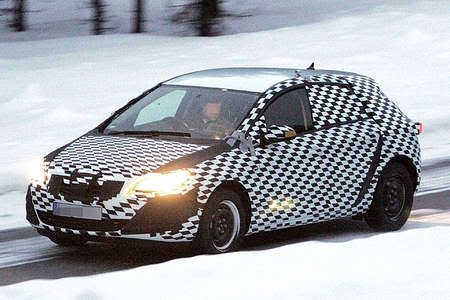
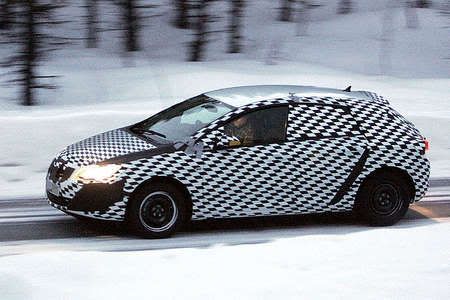
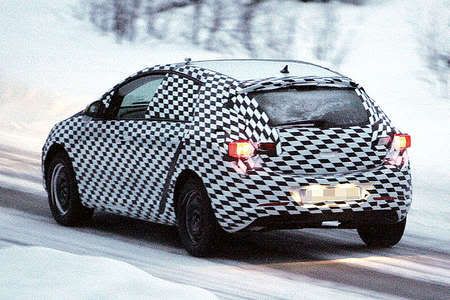
Ford unveiled their Focus facelift, we know Volkswagen is currently testing the Golf facelift but what is Vauxhall/Opel doing? Well, last weekend, spy photographers saw enginners undergoing cold-weather testing the new Astra in Northern Finland but the Astra is set to debut at the 2009 Geneva motorshow.

Despite the car’s disguise, the side profile, front fascia, rear bumper and tail lights overall shapes are visible. There is no insight into the 3-door model yet but it seems to be clear the five-door version will again get the current model’s sloping roof line plus the trapezoidal-shaped c-pillar.

Overall, the new car looks somewhat sleeker and yet more elegant. Besides the 5-door model pictured, Vauxhall/Opel will have a wagon, convertible and the 3-door in the pipeline, all following the 5-doors introduction, one by one.

The engine range will be similar to that used in today’s cars (75- to 240-bhp petrol units; 90- to 150-bhp diesels). Expect greener engines to arrive shortly after the car’s introduction.

Thursday, March 6, 2008

Toyota Urban Cruiser at the '08 Geneva motorshow


Toyota will launch its long-awaited UC (Urban Cruiser) in early 2009. The UK is expected to be one of the first markets to recieve the SUV.

Sliding rear seats, keyless entry and start, front & rear electric windows, leather steering wheel and steering wheel mounted audio controls, leather gearstick are all expected to be standard equipment. Options will vary from door sills to a satillite navigation system to metallic or mica paint to leather seats.

Press Release:

Toyota has given its new Urban Cruiser small SUV its European debut at the Geneva motor show, the latest addition to its distinguished 4x4 vehicle heritage. The new model is aimed firmly at the urban all-road market, where European sales have almost doubled since 2002. Scheduled to go on sale in the UK during the first half of 2009, it responds to customer demand for stylish SUVs with lower fuel bills and CO2 emissions: Urban Cruiser is expected to come in below the 140g/km emissions benchmark. Urban Cruiser draws on Toyota’s rich history of SUVs, which began in 1951 with the launch of the legendary Land Cruiser and went on to feature the landmark RAV4 in 1994 – the model which created the European compact SUV market. The new Urban Cruiser is designed as an aspirational urban SUV that is very close in spirit to the discontinued three-door RAV4 with its compact dimensions, clever packaging, practicality and four-wheel drive transmission.

Muscular Styling:

Urban Cruiser has the rugged, muscular appearance expected of an SUV, but with five-door practicality and compact dimensions that make it suitable for driving around town. It measures 3,930mm long, 1,725mm wide and 1,540 tall, with spacious accommodation for five inside, plus ample luggage space. A high belt line, additional bumper protection, prominent lower door sills and pronounced wheel arches give the vehicle a robust appearance. The headlamps flow back from the front grille, out towards the wings, further accentuating the car’s wide and tough road stance. Turn indicators are recessed into the door mirrors and the rear lamp units extend into the rear wings and tailgate. The show car is fitted with five-spoke 17-inch alloy wheels and a special Ice Blue paint finish. Urban Cruiser will play a significant role in cutting the overall emissions of Toyota’s model range to an average 140g/km by 2009.

Saturday, March 1, 2008

Diesel powered Cayenne on the way...


Porsche is being put under enormous stress in order to produce lower CO2 emissions from their cars. The London congestion charge will affect sales of all Porsches in London.

A 3.2 litre V6 diesel twin-turbocharger producing over 300bhp will be used and Audi will be developing it but during this time, Porsche will be producing their second Cayenne due for the 2010 model year. Other more powerful engines (V8, V10, and V12) were also considered, but eventually called off due to their heaviness.